Photo: Collected
Brazil launched the ABC Plan — Low Carbon Agriculture — in 2010. — becoming the first major emerging country to adopt explicit targets for mitigating greenhouse gas emissions in the agricultural sector. The initiative arose in response to the enormous environmental liability accumulated by Brazilian agriculture, especially related to degraded pasture areas. It is estimated that the country has approximately 100 million hectares of degraded pastures, equivalent to about 57% of the existing pastures in the national territory. This group of areas represents the largest environmental liability in the Brazilian agricultural sector and, at the same time, one of the greatest opportunities for productive and environmental recovery in world agriculture.
Degraded pastures are areas that have lost the capacity to sustain adequate biomass production and support efficient animal stocking rates. This process generally occurs due to inadequate soil management, prolonged overgrazing, lack of fertilization, and insufficient crop rotation. The result is compacted soil with active erosion, low water infiltration, and impoverished microbiomes, factors that reduce productivity and increase carbon emissions.
Pasture recovery surpasses targets and reaches 26,8 million hectares restored
Between 2010 and 2018, the implementation of the policies foreseen in the ABC Plan allowed for the recovery of approximately 26,8 million hectares of degraded areas, a number that exceeded the original target set for the period by 179%.
The initial goal was to recover 15 million hectares by 2020. The results obtained demonstrated the viability of productively recovering large areas of degraded land when combined with targeted rural credit and the adoption of sustainable agricultural technologies.

The program focused its investments on seven key technologies:
*recovery of degraded pastures
*direct planting system
*crop-livestock-forest integration
*biological nitrogen fixation
*planted forests
*animal waste treatment
*Adapting agricultural production to climate change.
Pasture recovery was responsible for approximately 51% of contracted resources, while the no-till planting system represented approximately 30% of investments.
In total, the funding linked to the program amounted to approximately US$5,96 billion between 2013 and 2021, allowing low-carbon agriculture technologies to be implemented on approximately 39 million hectares.
According to estimates from the Brazilian government, these practices resulted in a potential reduction of 193,67 million tons of CO₂ equivalent between 2010 and 2020, reinforcing the role of the agricultural sector in mitigating climate change.
Integrated crop-livestock-forestry systems are expanding rapidly and now cover more than 17 million hectares.
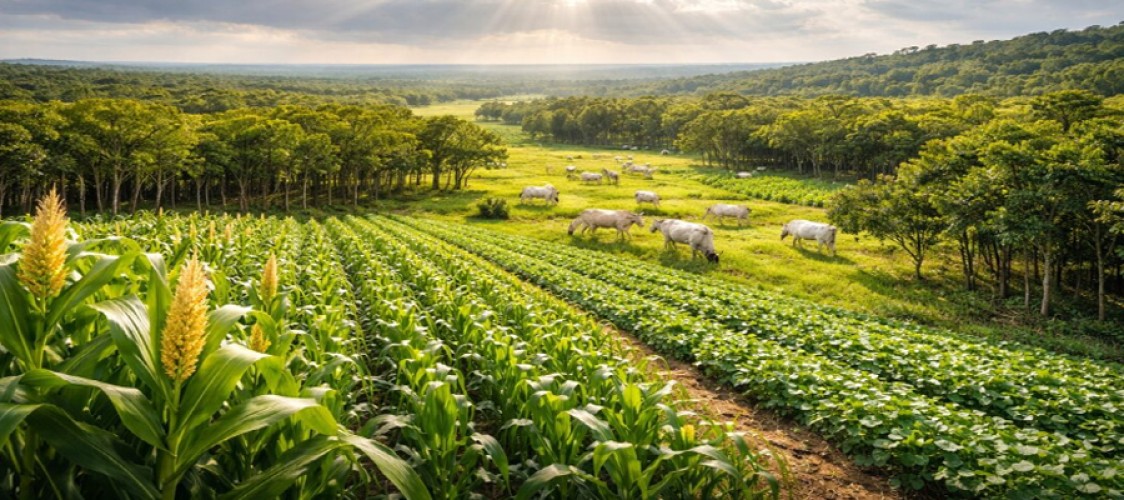
Among the technologies promoted by the ABC Plan, one of the most important is the Integrated Crop-Livestock-Forestry System (ILPF). This production system combines different agricultural activities in the same area through crop rotation, intercropping, or succession.
ILPF (Integrated Crop-Livestock-Forestry System) allows for the integration of agricultural production, livestock farming, and tree planting, creating ecological and productive synergies that increase the efficiency of land use.
Between 2015 and 2020, the area occupied by integrated systems grew rapidly in Brazil. The estimated extent increased from approximately 11,5 million hectares to something between 15 and 17,4 million hectares in 2020.
The states with the highest adoption of this model include Mato Grosso do Sul, Mato Grosso, Minas Gerais, and Rio Grande do Sul.
There are four main types of productive integration:
*crop-livestock (agropastoral)
*crop-livestock-forestry (agroforestry)
*livestock-forestry (silvopastoral)
*crop-forestry (silvoagricultural)
Between 2010 and 2015, approximately 5,96 million hectares managed under ILPF (Integrated Crop-Livestock-Forestry Systems) sequestered approximately 21,8 million tons of CO₂ equivalent, an amount comparable to the withdrawal of 4,7 million cars off the streets in one year..

No-till farming systems already cover more than 40 million hectares in Brazil
Another key technology in the ABC Plan is the no-till farming system. In this agricultural model, the soil is not tilled by plows or harrows, remaining protected by a layer of plant residues known as mulch.
Currently, the system covers more than 40 million hectares in Brazil, representing more than 60% of the total area dedicated to grain production.
The technique began to be developed in the south of the country in the 1970s and 1980s as a response to the rapid degradation of agricultural soils caused by intensive mechanization.
Direct planting requires crop rotation and constant maintenance of plant cover. In Brazil, forage grasses such as brachiaria have become fundamental in this system due to their ability to produce a large volume of biomass.
These plants are used both as livestock feed and as protective ground cover during the off-season.
Soil restoration can increase water retention by up to 2,5 times
Restoring degraded soils has direct effects on water retention capacity and crop resilience during periods of drought.
Experiments demonstrate that soils enriched with organic matter can significantly increase their water retention capacity. A classic study showed that the incorporation of 7,6 centimeters of organic compost at a depth of 15 centimeters increased water retention by 2,5 times. when compared to degraded sandy soils.
Soils with 4% organic matter can retain more than twice as much water compared to soils with only 1%. This is because organic matter has charged particles that attract water molecules through electrostatic forces.
On average, each 1% increase in organic matter content can allow the soil to store up to 20 additional gallons of water per acre. This effect reduces surface runoff, decreases erosion, improves infiltration, and increases water recharge in agricultural systems. See more.
See Also: https://gfmdhaka.com/
Source: Online/GFMM
























































Copyright © 2026 LIMRA Exhibitions. All Rights Reserved.
Website Design & Development ♡ MY SOFT IT
 EN
EN
 Chinese
 Turkish
 Indonesian
 German
 French
 Spanish
 Portuguese
 Russian
 Italian