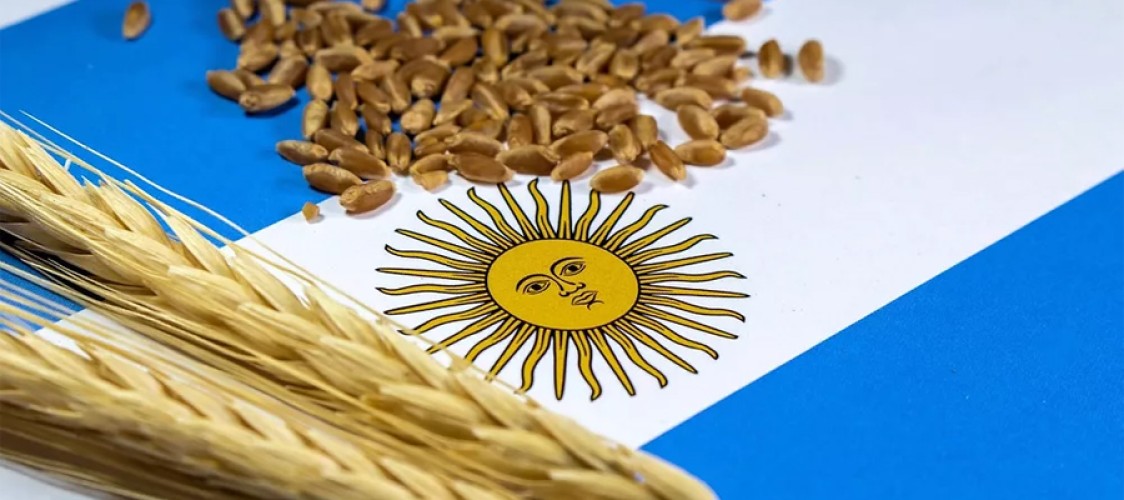
Bangladesh's wheat import sources started changing four years ago after the Russia-Ukraine war broke out in 2022. The biggest reflection of that change was seen in the just-ended 2025-26 fiscal year. For the first time, Argentina has become the top source of wheat imports for Bangladesh, surpassing Russia and Ukraine.
According to the National Board of Revenue (NBR), Bangladesh imported 7.434 million tons of wheat in the last fiscal year, which is the highest ever. Wheat imports increased by 25 percent compared to the previous fiscal year. About 30 percent of the total wheat imports came from Argentina.
Once upon a time, the two main sources of wheat imports for Bangladesh were Russia and Ukraine. Almost every fiscal year, one of the two countries was at the top. But in 2022, as supplies became uncertain due to the war between the two countries, importers started looking for alternative sources of wheat. In a few years, that alternative has now become the main source.
How Argentina is at the top
Argentina was already a source of wheat for Bangladesh. However, after the Russia-Ukraine war, imports from the country increased rapidly. As a result, Argentina was the fourth top wheat importer in Bangladesh in the 2024-25 fiscal year. The country has topped the list for the first time in the latest fiscal year.
According to the NBR, 2.2 million tons of wheat were imported from Argentina in the just-expired fiscal year. It cost 567 million US dollars. The country's share in total imports is about 30 percent.
On the other hand, imports from Russia have decreased to 1.679 million tons, which is 23 percent of total imports. However, 44 percent of Bangladesh's total wheat imports in the 2024-25 fiscal year came from Russia.
Bangladesh has been importing soybean oil from Argentina for a long time. This time, wheat has been added to that list on a large scale. Earlier, only a handful of companies imported wheat from the country, but 46 companies imported wheat from Argentina in the last fiscal year. One of these importers is Delta Agrofood Industries.
The company's Managing Director (MD) Amirul Haque told Prothom Alo, "After the Russia-Ukraine war, there was uncertainty in wheat imports from those two countries. Therefore, to reduce supply risk, we chose Argentina and Brazil as alternative sources."
Brazil is lagging behind
Russia, Ukraine, Argentina, Romania, Bulgaria and Brazil are the main sources of soft wheat in Bangladesh. Argentina has captured the largest share of the Russia-Ukraine market in Bangladesh. However, Brazil has also increased its share, but very slowly.
In the just-expired fiscal year, 476 thousand tons of wheat were imported from Brazil, which is 6.41 percent of total imports. In the 2024-25 fiscal year, 2 percent of total imports came from the country. At that time, Brazil was in seventh position in the wheat market imported into Bangladesh. And in the just-expired fiscal year, the country has risen from seventh position to fifth position.
According to NBR data, Brazil supplied wheat at the lowest average price in the last fiscal year. Wheat was imported from the country at $255 per ton. In the case of Argentina, this price was $257, meaning that even at a relatively low price, Brazil could not become a major source for Bangladesh.
Return of the United States
The main sources of high-protein durum wheat are Canada, Australia and the United States. The first choice of traders for this type of wheat is still Canada. In the just-expired fiscal year, 1.67 million tons of wheat were imported from Canada, which is about 22.5 percent of the total imports. As a result, the country is in second place among the wheat import sources of Bangladesh.
After a break of several years, the United States has returned to the wheat market of Bangladesh. No wheat was imported from the country in the 2024-25 fiscal year. In the last fiscal year, 744,000 tonnes of wheat came from the United States, which is about 10 percent of total imports. This makes the country the fourth largest source.
The US share has increased mainly due to official wheat imports. The government brought 95 percent of the total wheat imported from the country. The remaining 5 percent was imported by a private company.
According to importers, the Russia-Ukraine war has brought great diversity to the sources of Bangladesh's wheat imports. Where earlier there was high dependence on Russia and Ukraine, now there is increased participation of Argentina, Canada, the United States and Brazil. This has reduced the supply risk somewhat. However, international market prices and geopolitical situations still significantly affect Bangladesh's wheat imports.
You
can read South Asia's famous agricultural magazine on agricultural
reports through this link: https://gfmdhaka.com/
























































Copyright © 2026 LIMRA Exhibitions. All Rights Reserved.
Website Design & Development ♡ MY SOFT IT
 EN
EN
 Chinese
 Turkish
 Indonesian
 German
 French
 Spanish
 Portuguese
 Russian
 Italian